Autumn's in full swing, winter's steaming towards us and the mental load is about to go off the chart. So it felt like exactly the right moment for this conversation.
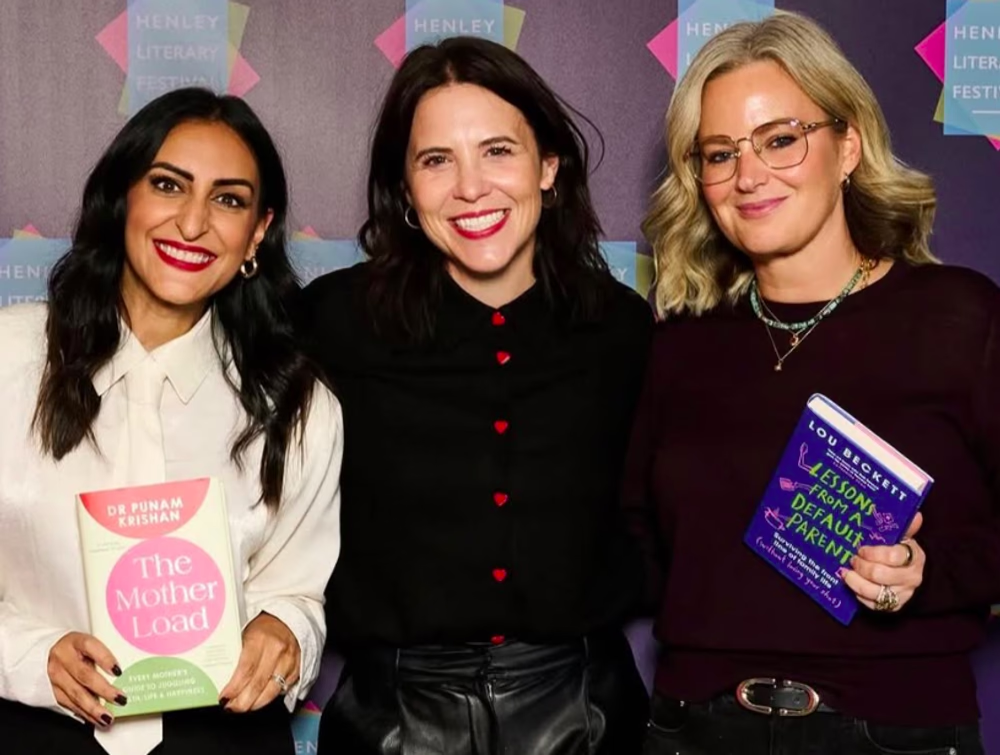
On the latest episode of The Don't Buy Her Flowers Podcast, Steph is joined live on stage at Henley Literary Festival by Lou Beckett, author of Lessons From a Default Parent, and Dr Punam Krishan, NHS GP and author of The Mother Load. One book looks at the sheer volume of what mums carry. The other looks at what all that carrying does to our bodies and minds. Together, with a glass of wine in hand and a room full of nodding heads, they made for an honest, funny and incredibly validating hour.
Catch the full episode here, which links straight to wherever you listen to your podcasts.
From a rage spiral to a bestselling book
Lou is refreshingly honest about where Lessons From a Default Parent began: "a bit of a rage spiral". For a while she'd been jotting notes on her phone about the things that were getting to her about life, mothering and, yes, her husband. She finds she's far more coherent (and more reasonable) when she writes things down, so she turned those notes into a blog post, showed it to Rob, and he said she should put it out there. It became a way of getting the frustration out without a big old row.
Punam sees the other side of that in her GP surgery every week. Mums who haven't been able to say how they feel eventually come into clinic saying, "I don't know who I am anymore. I don't recognise myself." For Punam, The Mother Load started 13 years ago when her son was born. Despite years of medical training, she had a traumatic birth, was very unwell and went on to have postnatal depression, and found there was nothing to help her understand what came next. After the six-week check, she says, mums just "fall off a cliff".
Becoming the default parent without ever deciding to
Lou never remembers sitting down and agreeing to be a stay-at-home mum. She was a secondary school teacher, but her ulcerative colitis flared badly in her last year of teaching just as she got pregnant. Rob's career was taking off at the same time, and they simply scrabbled to meet everyone's needs. Six or seven years later she realised she couldn't remember signing up for the version of life where she didn't do anything else.
She loved it, but that's the trap. Wanting something just for you can feel ungrateful, as if you don't love your children or motherhood enough. As Lou puts it, you can love your child and also want to leave the house sometimes. Those two things aren't mutually exclusive.
One of the biggest shifts was losing the freedom to just go out. After years as a fully grown adult, she suddenly had to organise babysitters and check the fridge before she could nip to the pub. Lou says that, realistically, their set-up probably wouldn't have looked any different if they'd talked it through. But it would have been a deliberate decision, and these days it feels deliberate, which makes all the difference.
The invisible workload of anticipating everyone's needs
Steph raised the part of the load that's hardest to see: thinking of everything before anyone asks. At Christmas, that's knowing who can't eat what and who really loves those potatoes. What does that do to us? "It makes us drink," says Lou, to plenty of knowing laughter.
Punam explains that nobody prepares you for the mental and emotional load that comes with motherhood. Before you know it, you're organising every appointment, running every schedule and looking after everyone's emotional needs. Many women are also in the "sandwich generation", caring for ageing relatives as well as children while holding down work. There's only so much capacity a person has, and eventually it shows up as waking at 3am with lists running through your head, anxiety, panic attacks or gut problems.
When mums sit in her clinic and ask what they're doing wrong, her answer is simple: you're doing nothing wrong. Look at all the demands on you. Of course you feel run down and exhausted.
Talking about it without it feeling like an attack
Lou worried that people would read her book and think she was lazy or selfish. Instead, she was flooded with messages from mums at every stage, including grandmothers who said they wished they'd spoken up or hadn't realised how big a job they'd been doing. Her reply? You're not "just a mum". It's hard because it's hard.
Writing the book has made the division of labour at home much more intentional. It isn't about a perfect 50/50, because their workloads aren't 50/50. It's about checking in every so often and asking whether it's still working for everyone, and if not, what could change. Lou remembers a row in a shop, long before she had the language for any of this, when all she could say was "just let me win this one" and admit she was more tired.
The group agreed that raising any of this can feel like an attack when everyone's already working so hard. Steph mentioned her recent conversation with Alex Trippier of Be a Happier Parent, who explains how many of us are still living out traditional roles while trying to be modern at the same time. That's confusing for everyone, men included, many of whom grew up being told their job was to earn and provide.
Punam added that communication is the starting point, even though it isn't easy. Women often confide in a best friend rather than their partner, and that disconnect leads to frustration and resentment. One common example in her clinic is a loss of interest in sex. After a day of being needed by everyone, many mums simply feel touched out, while their partner may read it as rejection. Explaining how you feel might take a few attempts, but it benefits everyone.
Dress-up days, class WhatsApps and the Christmas teacher collection
Then there's school. The WhatsApp groups, the themed dress-up days, the non-uniform day you only remember at 8.15am. The panel agreed modern motherhood was never designed for this volume of admin. Punam admits that her last patient of the day sometimes gets a silent plea of "please be tonsillitis" so she can make it to the school gate. Steph would happily pay £20 to opt out of every dress-up day, and there was a heartfelt round of thanks for the class rep mums who send a Sunday night bulletin of everything needed that week.
Lou tried handing the class rep job to Rob. By November he announced he wasn't doing the teachers' Christmas collection because mums "make too much work for ourselves". Which, as Lou points out, is about 50% of the job. She took it back, and the rest of the year spiraled straight back to her.
Why your body keeps the score
Punam explains that we're not designed to be "on" all the time. Stress hormones like adrenaline and cortisol are meant for short bursts. Living with them day after day is like constantly feeling there's a lion chasing you, and over time it builds up inflammation that will come out somewhere. That might be high blood pressure, palpitations, gut issues, anxiety or depression.
Many mums normalise the fatigue, the sleepless nights, back pain, pelvic floor problems and incontinence as just part of motherhood, and suffer in silence. Punam often sees women in their late 30s, 40s and 50s who've lived with an issue for years because they thought it was normal. As perimenopause arrives, it's easy to put everything down to hormones, when there may be something else going on underneath.
We'd book an appointment in a heartbeat if our child had a headache, or nag our partner to see the doctor. Yet mums put themselves at the bottom of the list. Punam recently saw a mum who asked if they could just see her feverish child instead, and she'd come back another time. Punam's answer: no, we need to see both of you, because you're just as important.
Dr Punam on her breast cancer diagnosis and advocating for yourself
Punam shared that just over a year ago she noticed a persistent ache in her arm that just didn't feel right. When she saw her GP, she brushed it off as probably stress or perimenopause. Her doctor paused, examined her, and sent her for checks. It turned out to be breast cancer. Punam is well now, but it was a really difficult time, and something she never expected to hear, even as a GP.
Her message is clear. None of us is immune, even without risk factors, so if something in your body changes, get it checked and advocate for yourself. So many women miss smear tests or mammograms because life is busy and everything else feels more important.
She also talked about what it's like to be unwell with young children. You don't have the luxury of falling apart; you still have to show up. A year on, she guards her sleep like her life depends on it, looks after what she eats and puts her walks and gym sessions in the family calendar as non-negotiables. A friend who'd also had breast cancer told her there would be "gifts along the way". At the time Punam couldn't imagine what they'd be, but she now says her friend was right: one of them has been learning to look after herself, guilt-free.
Letting go of the guilt (and a bit of the control)
If guilt comes out with the placenta, as Punam jokes, how do we shift it? Lou's approach is to sit with it. When she feels the urge to lay out everyone's clothes for the week before she goes anywhere, she reminds herself that Rob is perfectly capable of finding the school uniforms. It might not be done her way, but the guilt passes if you sit with it long enough.
Punam's lesson came from saying yes to Strictly Come Dancing. Her husband reminded her that when they first met, the two things she said she wanted were children and Strictly. With clinics during the day and training from 6pm until midnight, she had no capacity for remembering blue day or yellow day. The kids were fed, they got to school, and if hair wasn't perfect, it was fine. She realised that much of what we try to control every day isn't really that important, and after about ten years of motherhood, she felt she'd found herself again.
And for a dose of honesty, Lou admits that when Rob tore his ankle ligaments playing football while she had a three-year-old and a one-year-old, she told him to "get better or die". Not her finest hour, she says, but she stands by it.
You matter too: the takeaways
To close, Steph asked each guest for the one thing they'd like listeners to take away.
For Punam, it's advocating for yourself and knowing you're a priority. Learn about your body, feel empowered by it and speak up when something doesn't feel right. You matter at every stage of motherhood.
For Lou, it's to stop feeling bad about everything all the time. There's no one right way to be a mum, so give yourself time to work out what works for you, and be as kind to yourself as you would be to your friends. Punam added: turn some of the love you give your children back towards yourself.
Both books end on the importance of connection and friendship. Motherhood can be isolating, and it's easy to compare yourself with whoever seems to be doing it better. But in your own unit, you're doing the best you can for your family, and that's enough. We've got far more in common than we think.
Meet Lou Beckett and Dr Punam Krishan
Lou Beckett is a mum of two, a former secondary school teacher and wife to comedian Rob Beckett. She's the (mostly) silent participant of the hugely popular Parenting Hell podcast and author of the Sunday Times bestseller Lessons From a Default Parent. You can follow Lou on Instagram.
Dr Punam Krishan is a practising NHS GP, mum of two and bestselling author based in Glasgow. She's the resident GP on BBC Morning Live, writes for The i Paper on maternal health, family life and everyday wellbeing, and was shortlisted for the British Journalism Award in 2021. Her books include The Mother Load and, for children, Me and My Feelings and The Superhero's First Aid Manual. You can follow Punam on Instagram.